
Somewhere on your campus there is a shared drive with a folder named something like "COE 2018." Inside it is the last comprehensive visit: the old self-study, a zip of appendices, a spreadsheet of who owned which standard. Most of those people have new jobs now. The next visit is closer than the last one feels, and the Council already publishes the date on its public list of accredited colleges. The question that lands on the accreditation lead's desk is not philosophical. It is: which documents govern us this cycle, who produces each piece, and when does each piece have to exist?
This guide is the operational answer for DVM deans and accreditation leads: the named documents in force, the working structure that produces them without heroics, and the failure points that show up late, when they are expensive. A downloadable accreditation tracker (branded Excel workbook, with a plain-CSV alternative) is linked at the end as a meeting handoff, not as the system of record. The species-and-competency product walkthrough lives on the veterinary education page; this page stays on the calendar and the owners.
Verified September 1, 2026 against the July 2025 AVMA COE Policies and Procedures, Appendix E, classifications, accredited-colleges list, and FAQs. Sources at the end.
First, the documents in force
AVMA COE accreditation runs on a small number of named documents. Managing the process starts with knowing exactly which ones govern you, in which edition.
The Policies and Procedures manual. The Council publishes Accreditation Policies and Procedures of the AVMA Council on Education (July 2025 edition). The edition fetched for this guide is dated July 2025. An older file (January 2025, revised March 2025) is still hosted on avma.org. If your tracking spreadsheet was built on the January file, the first task is a diff, not a review.
The Standards of Accreditation. Eleven standards, numbered 1 through 11: Organization; Finances; Physical Facilities and Equipment; Clinical Resources; Information Resources; Students; Admission; Faculty; Curriculum; Research Programs; Outcomes Assessment. The standard is the unit the college is reviewed against. The full description of the criteria, and the evidence required to determine if each Standard is met, lives in Appendix E (Self-Study Guidelines), not in a saved crosswalk.
The self-study. The Council calls the self-study report the single most important document of the accreditation process, and the principal element of evidence that the program and resources of the college comply with the Standards. Administrators, faculty, students, and alumni should be consulted in preparing it. The site visit exists to clarify and verify that the self-study is a true reflection of the college, not to invent the record.
Appendix E, Appendix K, and the rubric. Appendix E is the self-study outline. Appendix K is the Annual Interim Report Guidelines for accredited colleges. Appendix I is the comprehensive site-visit rubric. Pull the current files from avma.org at the start of each cycle.
The public list. The accredited-colleges page is the only official internet list of AVMA COE-accredited programs, and it carries accreditation status and the date of the next site visit. Put that date in the tracker first.
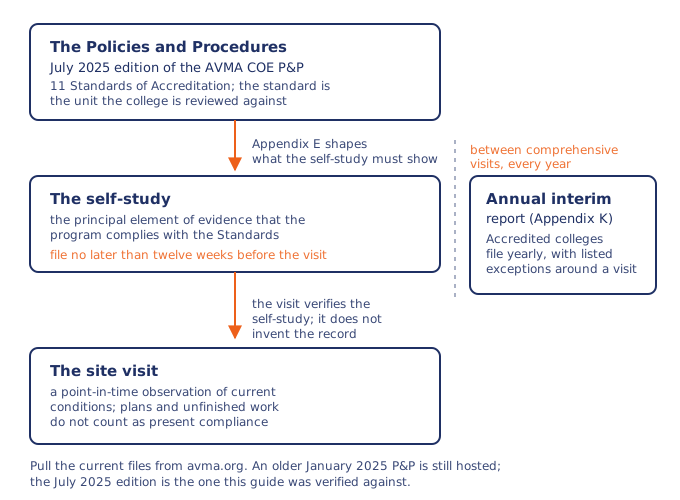
The operational rule that follows: never work from a saved copy. Pull the July 2025 (or later) P&P, Appendix E, and Appendix K from avma.org, record the edition date, and settle any argument between a prior binder and the current manual by siding with the current manual.
The cycle at altitude
To maintain accreditation, veterinary colleges must provide an extensive self-evaluation and arrange for a site visit at intervals of not more than seven years. Your college's actual next-visit date lives in COE correspondence and on the public list; that date, not a typical interval, is the one to plan against.
| Owner | Clock | Artifact |
|---|---|---|
| Accreditation lead | Visit interval of not more than seven years; YOUR date on the public list | Next-visit date in the tracker |
| Accreditation lead | Annual, except around a recent or imminent visit | Filed annual interim report |
| Colleges with Accredited with Minor Deficiencies, Probationary, or Terminal | Every six months | Progress report |
Comprehensive site visits for accredited colleges in the US and Canada are conducted at least every 7 years. Between comprehensive visits the process does not go quiet. The Council requires an annual interim report from each college with Accredited status, except when a site visit has been conducted less than six months previously, or when a site visit is planned to occur in the first six months of the following year. Colleges with Accredited with Minor Deficiencies, Probationary Accreditation, or Terminal Accreditation status submit progress reports every six months. The annual report is how the Council monitors continued compliance. The visit is a point-in-time observation. The P&P's own phrase is a still photograph of a dynamic process.
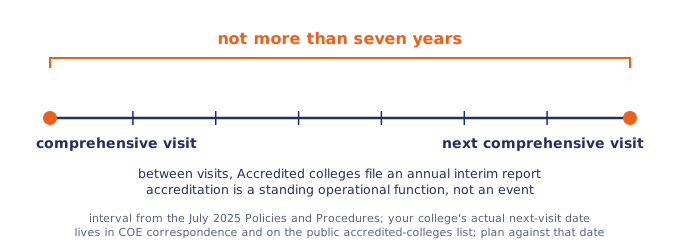
A 30-second check. Open the Council's accredited-colleges list. Write your next visit date in the tracker. The rest of this guide works backward from that date.
The operating model that survives turnover
People → Process → Platform. Named owners run the AVMA COE cycle as a standing process. The self-study, the annual interim report, and the visit interval of not more than seven years are that process. A platform comes last, to make the process survive turnover.
The expensive failures are not usually ignorance of the eleven standards. They are a process that lives in one person's head. The structure below is boring on purpose.
A named accreditation lead with real authority. Usually an associate dean or a dedicated accreditation director. This person owns the calendar, the master documents, and the escalation path to the dean. If this role is somebody's fifth job, the tracker below is fiction.
Standard owners, in writing. Every one of the eleven standards gets a named owner: the person who can produce the evidence and the narrative, not the most senior person nearby. The owner list is a living document. It is the first thing to update when people leave.
A standing data steward for outcomes. NAVLE school score reports, attrition, employment, graduate and employer feedback. Most painful visit moments are not standards arguments. They are a narrative on page one that contradicts a table in Appendix E, because two offices answered the same question from different systems.
An off-campus inspection owner. Off-campus required training sites must be directly (in-person) and regularly (no less than annually) inspected and overseen by qualified college personnel. If that inspection lives in email, it is not operational.
The dean's visible sponsorship. Standard owners hit walls only the dean can remove: data access, faculty time, honest answers to uncomfortable questions, and any plan that is a substantive change. A kickoff where the dean personally charges the work is worth more than any folder.
The timeline, built backward
Dates the Council sets override everything here. Put them in the tracker first.
| Owner | Clock | Artifact |
|---|---|---|
| Dean + accreditation lead | At least nine months before the end of the period | Current P&P in hand; owner list charged |
| Accreditation lead | No later than twelve weeks before the site visit | Self-study filed with AVMA and each site team member; not more than 105 pages |
| Site team | The visit itself (FAQ: at least four days) | Verification of the self-study, not of plans |
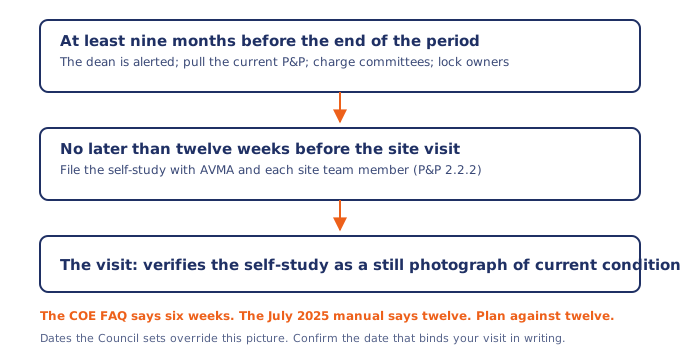
At least nine months before the end of the accreditation period. The P&P says the dean is alerted to the requirements for preliminary reports, and arrangements for a site visit are made. A copy of the current P&P is sent to the dean. If that alert has not happened, do not wait for it. Pull the current manual and start the owner list.
No later than twelve weeks before the site visit. Section 2.2.2 of the July 2025 P&P: the college must provide the self-study as a hard copy (one only) and in electronic format to the AVMA office, with copies to each site team member. Failure to file a suitable report by the deadline, and in the formats specified, may result in postponement of the site visit. The self-study should not be more than 105 pages in total, inclusive of appendices, with a minimum of size 11 font.
The FAQ says something else. The COE FAQs page fetched the same day says the self-study is due no later than six weeks before the site visit, and describes a 100-page self-study. That is a real discrepancy, not a rounding error. Plan against the Policies and Procedures manual in force (twelve weeks, 105 pages). Confirm the date that binds your visit with your COE staff contact, in writing, and put that date in the tracker.
The visit itself. The FAQ describes a visit that lasts at least four days: facilities, interviews with administration, faculty, students, and standing committees. The P&P is explicit that the team should not evaluate plans, unfinished renovations, projected equipment purchases, or other non-existing conditions as if they were current compliance.
Every year that is not a visit year. File the annual interim report. Screen planned changes against the substantive-change list in section 3.4 before anyone implements them. The COE must be notified, and the COE must grant approval, prior to implementation of any substantive change. Enrollment jumps, new sites, and distance education are on that list. Reporting after the fact is not the same as approval.
Two Standard facts that belong on the tracker
This guide does not paraphrase the eleven standards. Two numbers from the July 2025 P&P belong on the tracker because they are easy to reconstruct too late.
Standard 9, Curriculum. The curriculum must provide at least 130 weeks of direct instruction. The summative, concluding period of clinical instruction must include a minimum of 40 weeks of hands-on clinical education involving the prevention, diagnosis, treatment, or mitigation of disease related to animal health, or other experiential, workplace-based learning that is supervised through real-time interactions with the instructor(s). The curriculum as a whole must be reviewed at least every seven (7) years. Weeks reconstructed from calendars in a visit year are not weeks.
Standard 11, Outcomes Assessment. New graduates must have the basic scientific knowledge, skills, and values to provide entry-level health care, independently, at the time of graduation. Processes must be in place to remediate students who do not demonstrate competence in one or more of the nine competencies the Standard lists. The Council on Education expects that 80% or more of each college's graduating senior students sitting for the NAVLE will have passed at the time of graduation. That sentence is the Council's published expectation. This page does not report any college's rate, and nothing here promises an accreditation outcome. Each institution reports 5 years of NAVLE results for its graduates in the annual interim report and in self-studies.
Where it goes wrong
- The January binder. Tracking built on the January 2025 P&P (or an older printout) and never diffed against July 2025. Cheap fix: the first row of the tracker, with a name on it.
- The FAQ deadline. An internal calendar built on six weeks because that is what the FAQ says. The manual in force says twelve. Confirm in writing; plan against twelve unless your COE contact says otherwise.
- The self-study as archaeology. If the self-study only exists in visit years, every cycle starts by excavating what changed since the last one. The annual interim report is supposed to reduce that pile. Use it that way.
- Off-campus sites inspected on paper. Standard 3 requires in-person inspection, no less than annually, of required off-campus training sites. A spreadsheet of affiliates is not that inspection.
- Narratives that contradict tables. NAVLE tables, attrition, employment, and the nine-competency record. Assign one data steward, one source system per table, and a consistency pass before anything is submitted.
- A substantive change already in motion. Section 3.4 requires approval prior to implementation. A class-size or site decision that reaches the dean as a fait accompli has already spent the buffer.
- Single-person knowledge. Every artifact (master self-study, owner list, correspondence, this tracker) lives in a shared, access-controlled location the moment it exists. Turnover should cost you a person, never a process.
The tracker
Download the AVMA COE accreditation tracker (Excel), or the plain CSV if you would rather import it into Google Sheets or your own system: every task above as a row, grouped by phase, with columns for the suggested owner, timing, status, and notes. The workbook is a handoff for a meeting (names and dates in a file you can pass around). It is not the system of record. Put real names in the owner column at your next leadership meeting, and the standing list lives in the platform.
Where a platform helps
People → Process → Platform. Named owners run the AVMA COE cycle as a standing process. The tracker is a meeting handoff. A platform comes last. Medtrics is one such platform. See Veterinary Education.
The packet is not a visit-year folder. Medtrics keeps every accreditation artifact in one access-controlled repository, categorized, with expiration alerts, and links each artifact as evidence to the standard it supports.
The cycle is a workflow with owners. It tracks a multi-year accreditation effort, phases, owners, due dates, and directed update requests, in one workflow.
Goals and Outcomes
Needs your attention
Showing top 2 by due dateRequired evidence not linked
Program director · Sep 5, 2026
Unanswered required questions
Unassigned owner · Sep 8, 2026
AY 2026-2027 Annual Program Evaluation
Complete outcomes, evidence, metrics, requests, and action planning before submitting the packet for review.
Improvement goals
8
Open blockers
2
Open actions
5
Overdue actions
1
Demonstration data. Packet artifacts live in one access-controlled repository, linked to the standard they support.
The species-diversity and clinical-competency walkthrough belongs on the veterinary education page, not here. This guide stays on the documents, the calendar, and the owners.
None of this replaces the operating model. The calendar, the owners, and the dean's sponsorship still do the work; a platform makes the boring structure durable when people leave.
Sources and status
This guide was verified against the following AVMA COE primary sources, each fetched on September 1, 2026. Whatever this page says, the authoritative version of every requirement is the current edition on avma.org, not any article, including this one.
- Accreditation Policies and Procedures of the AVMA Council on Education, July 2025 edition: eleven standards; self-study as the principal evidence document; filing no later than twelve weeks before the visit; 105-page cap; site visits at intervals of not more than seven years; annual interim reports; Standard 9 instructional-week figures; Standard 11 NAVLE expectation and nine competencies; nine-month dean alert; substantive-change approval prior to implementation. avma.org, coe-pp-July-2025.pdf
- Appendix E Self-Study Guidelines, July 2025. avma.org, coe-pp-appendix-E-self-study-guidelines-July-2025.pdf
- COE P&P principles HTML: last update to this section, July 2025. avma.org, coe-accreditation-policies-and-procedures-principles
- COE classifications: Accredited for a maximum of 7 years with interim reporting; annual interim report rules. avma.org, coe-accreditation-policies-and-procedures-classifications
- Accredited veterinary colleges list: official public list; next-visit dates; annual interim reports. avma.org, accredited-veterinary-colleges
- COE FAQs: six-week / 100-page phrasing (flagged above as conflicting with the P&P); visit lasts at least four days. avma.org, coe-faqs
AAVMC publishes that the COE is jointly supported by AAVMC and AVMA, and that accredited institutions are required to be reaccredited every seven years. That is member-org context, not a substitute for the Standards text. aavmc.org/community/accreditation
AVMA and the Council on Education are named descriptively. This article is an independent operational guide from Medtrics, not AVMA or COE guidance, and nothing here promises any accreditation outcome; the work does that, or nothing does.