Somewhere on your campus there is a shared drive with a folder named something like "LCME 2019." Inside it is the last site visit: the old data workbook, the old self-study, a spreadsheet of who owned what. Most of those people have new jobs now. The next visit is closer than the last one feels, and the question that lands on the accreditation lead's desk is not philosophical. It is: what do we actually have to produce, who produces it, and when does each piece have to exist?
This guide is the operational answer for MD-program deans and accreditation leads: the document set that governs an LCME review, the working structure that produces it without heroics, and the failure points that show up late, when they are expensive. A downloadable readiness checklist (branded Excel workbook, with a plain-CSV alternative) is linked at the end, with owner and target-date columns so the work is visible years before the deadline is.
Verified August 16, 2026 against LCME Functions and Structure (2026-27), current DCI, and ISA materials. Sources at the end.
First, the document set
LCME accreditation runs on a small number of named documents. Managing the process starts with knowing exactly which ones govern you, in which edition.
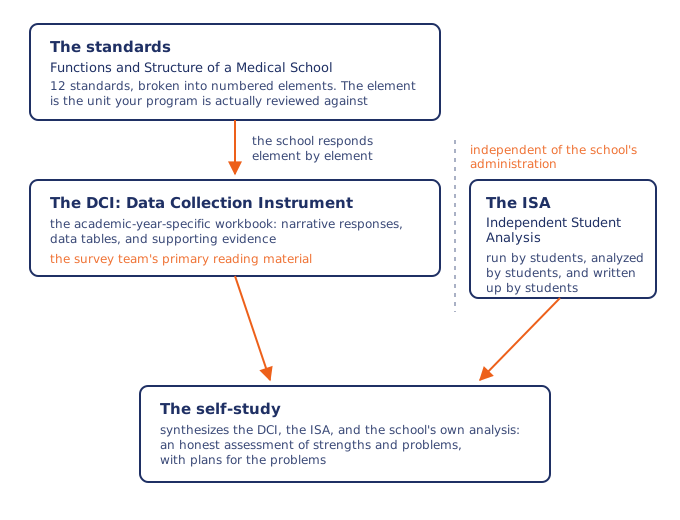
The standards. The LCME publishes its standards in Functions and Structure of a Medical School, revised and reissued for each academic year. In the 2026-27 edition (published May 2025), the requirements are organized as 12 broad standards, each broken into numbered elements. The element is the unit your program is actually reviewed against. A 2027-28 edition was published in April 2026, effective July 1, 2027, with revisions to the content of some standards. Use the edition that matches your survey's academic year, and check the LCME's "Substantive Changes to Publications" page at the start of each cycle: an element that moved or changed can silently break a tracking spreadsheet built on last year's document.
The DCI. The Data Collection Instrument is the academic-year-specific workbook where the school documents its performance element by element: narrative responses, data tables, and supporting evidence. It is the backbone of the self-study and the survey team's primary reading material.
The ISA. The Independent Student Analysis is the students' own review: run by students, analyzed by students, and written up by students, independent of the school's administration. The school supports logistics; it does not steer findings. Treating the ISA as a document the dean's office edits is both a process failure and exactly the kind of thing a survey team notices.
The self-study. The institutional self-study synthesizes the DCI, the ISA, and the school's own analysis into an honest assessment of strengths and problems, with plans for the problems. The LCME publishes guides for the self-study and survey process; use the current ones.
The operational rule that follows from all four: never work from a saved copy. Pull the editions that apply to your visit cycle from lcme.org at the start of each academic year, diff them against what your tracking is built on, and confirm with your LCME survey contact which edition governs your visit when the answer is not explicit. One navigation note as of this guide's verification date: LCME publications are no longer collected on a single page. The standards documents now live under the Resources tab on lcme.org.
The cycle at altitude
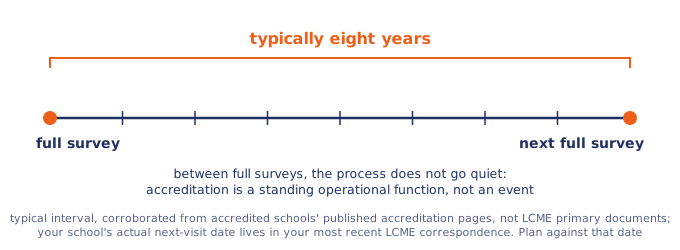
Full accreditation surveys typically run on an eight-year cycle, an interval corroborated here from accredited schools' published accreditation pages, not from the LCME documents named in Sources. Your school's actual next-visit date lives in your most recent LCME correspondence, and that date, not the typical interval, is the one to plan against. Between full surveys, the process does not go quiet: annual questionnaires, status reports on any elements flagged for follow-up, and notifications for substantial changes (class size, curriculum structure, campuses) all continue. The schools that find site-visit years manageable are the ones that treat accreditation as a standing operational function, not an event.
The operating model that survives turnover
The recurring pattern in programs that struggle is not ignorance of the standards. It is that the process lives in one person's head. The structure below is boring on purpose.
A named accreditation lead with real authority. Usually an associate dean or a dedicated accreditation director. This person owns the calendar, the master documents, and the escalation path to the dean. If this role is somebody's fifth job, the timeline in the checklist below is fiction.
Element owners, in writing. Every element in the current standards gets a named owner: the person who can actually produce the data and the narrative, not the most senior person nearby. The owner list is a living document; it is the first thing to update when people leave.
A standing data steward for the DCI. Someone accountable for the data tables staying current and internally consistent: enrollment, faculty, finances, outcomes. Most painful site-visit moments are not standards violations; they are a narrative on page one that contradicts a table on page two hundred, because two offices answered the same question from different systems.
A student committee for the ISA, early. Students graduate on a schedule that does not care about your visit date. The ISA committee needs to form, survey the student body, analyze, and write while its leaders are still enrolled, and the results need to exist before the self-study synthesis starts, because the self-study is supposed to respond to them.
The dean's visible sponsorship. Element owners hit walls only the dean can remove: data access, faculty time, honest answers to uncomfortable questions. A kickoff where the dean personally charges the task force is worth more than any tracking tool.
The timeline, built backward
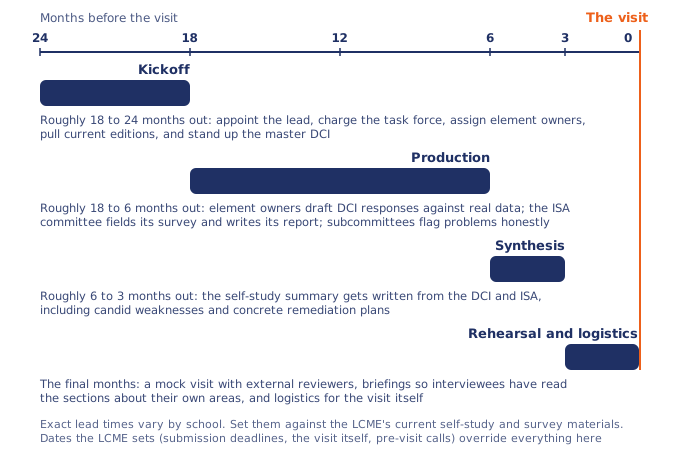
Exact lead times vary by school and should be set against the LCME's current self-study and survey materials, but the architecture is stable, and the checklist template mirrors it. Working backward from the visit:
- Kickoff (roughly 18 to 24 months out). Appoint the lead, charge the task force, assign element owners, pull current editions, and stand up the master DCI. Starting later converts everything below into a scramble.
- Production (roughly 18 to 6 months out). Element owners draft DCI responses against real data; the ISA committee fields its survey and writes its report; subcommittees review each standard and flag problems honestly. Problems found here are fixable; problems found by the survey team are findings.
- Synthesis (roughly 6 to 3 months out). The self-study summary gets written from the DCI and ISA, including candid discussion of weaknesses and concrete remediation plans. A self-study that claims no problems is not reassuring; it is implausible.
- Rehearsal and logistics (the final months). A mock visit with external reviewers who have survey experience; briefings so the people the team will interview have actually read the sections about their own areas; logistics for the visit itself.
Dates the LCME sets (document submission deadlines, the visit itself, any pre-visit calls) override everything here. Put them in the tracker first and schedule backward from them.
Where it goes wrong late in the cycle
The failure points below are the ones that surface late, cost the most, and are cheapest to prevent early.
- Last-edition drift. The tracking spreadsheet was built on a prior year's standards, and nobody diffed the new edition. Cheap fix: a standing task, every year, owned by the accreditation lead.
- The DCI as archaeology. If the DCI only exists in visit years, every cycle starts by excavating what changed since the last one. Schools that maintain a continuously updated master DCI, reviewed on a fixed annual rhythm, walk into the cycle with a draft instead of a dig.
- The ISA started too late. Building student response rates takes a full term; analysis and writing take another. An ISA that finishes after self-study synthesis has started can only be appended, not addressed, and the gap shows.
- Narratives that contradict tables. Assign one data steward, one source system per table, and a consistency pass before anything is submitted.
- Follow-up treated as filing. Any element flagged for monitoring after the visit is a project with an owner and a due date, not a letter to file. The next status report is written from that project's record.
- Single-person knowledge. Every artifact (master DCI, owner list, correspondence file) lives in a shared, access-controlled location the moment it exists. The folder named "LCME 2019" should be a running archive, not a mystery.
The checklist
Download the LCME readiness checklist (Excel), or the plain CSV if you'd rather import it into Google Sheets or your own tracker: every task above as a row, grouped by phase, with columns for the suggested owner, timing relative to the visit, status, and notes. Import it into Excel or Google Sheets, put real names in the owner column at your next leadership meeting, and the next cycle becomes a plan instead of a folder.
Where a platform fits
Nothing in this guide requires particular software; the operating model above works in spreadsheets and shared drives, and the checklist assumes nothing more. But four of the failure points are, at bottom, records problems, and a purpose-built platform addresses them directly. Medtrics is one such platform, so here is the honest mapping.
The owner list that goes stale: Medtrics loads LCME elements as a native accreditation framework, assigns named owners with due dates to each element, and tracks submit, review, and approve status as a living list. The "LCME 2019" folder: it keeps every accreditation artifact in one access-controlled repository, categorized, with expiration alerts, and links each artifact as evidence to the standard it supports. Narratives that contradict tables: enrollment, evaluations, and outcomes live in one system of record with a governed KPI layer and exportable analytics. And the long cycle itself: it tracks a multi-year accreditation effort (phases, owners, due dates, and directed update requests) in one workflow.
None of this replaces the operating model; the calendar, the owners, and the dean's sponsorship still do the work. A platform makes the boring structure durable when people leave.
Sources and status
This guide was verified against the following LCME primary sources on August 16, 2026:
- Functions and Structure of a Medical School, 2026-27 edition (published May 21, 2025): 12 standards broken into numbered elements. A 2027-28 edition was published in April 2026, effective July 1, 2027. Pull the edition that matches your survey year from the Resources tab. lcme.org/publications
- LCME Publications page: publications are no longer collected on a single page; standards documents live under the Resources tab. lcme.org/publications
- LCME Substantive Changes to Publications: check at the start of each cycle; an element that moved or changed can silently break a tracking spreadsheet built on last year's document. lcme.org/substantive-changes-to-publications
- The Data Collection Instrument, Independent Student Analysis materials, and the LCME's self-study and survey guides, as published on lcme.org. Pull the editions that apply to your visit cycle from the current site. lcme.org
The typical eight-year interval between full surveys is corroborated from accredited schools' published accreditation pages, not from the LCME documents named above, and is marked as such where it appears. Your school's actual next-visit date lives in LCME correspondence.
After publication, the current editions on lcme.org remain the only authoritative statement of any requirement.
LCME, AAMC, and AMA are named descriptively. This article is an independent operational guide from Medtrics, not LCME guidance, and nothing here promises any accreditation outcome; the work does that, or nothing does.