
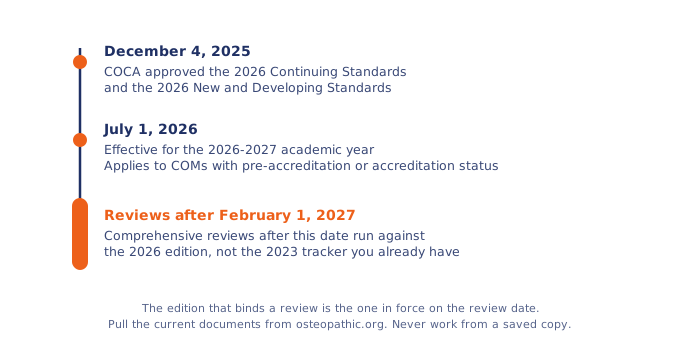
On December 4, 2025, the Commission on Osteopathic College Accreditation approved a new edition of its continuing accreditation standards, and a matching new-and-developing edition for applicant and pre-accredited colleges. The documents took effect July 1, 2026. Reviews conducted after February 1, 2027 run against that edition. If your tracking spreadsheet still says 2023 in the header, the calendar has already chosen for you.
This guide is the operational version for DO deans and accreditation leads. It covers the named documents in force, the two dates that decide which edition governs a review, the structure that survives turnover, and the failure points that surface late. A downloadable edition-transition tracker (branded Excel, with a plain-CSV alternative) is linked at the end as a meeting handoff, not as the system of record.
Verified September 1, 2026 against COCA. Sources at the end.
First, the documents in force
COCA accreditation runs on named documents. Managing the process starts with knowing which binder you are in.
| Document | Who it governs | What it is not |
|---|---|---|
| Continuing Accreditation Standards (2026) | Currently accredited colleges of osteopathic medicine. The 2026 edition is organized as 12 standards, each broken into numbered elements. The element is the unit a review actually tests. Standards 1 through 11 must be met for full accreditation. Standard 12 applies only when COCA serves as the institutional accreditor. | a substitute for the New and Developing binder |
| New and Developing Accreditation Standards | Applicant and pre-accredited programs. Its own document, its own reporting tables. | interchangeable with the continuing set |
| Reporting tables | Each edition ships with accompanying tables. They change when the edition changes. | a table saved from 2023 reused as a 2026 submission |
| Comparison of the 2023 and 2026 continuing standards | COCA published a comparison of the 2023 and 2026 continuing standards. That document is the first row of the tracker, not a later one. | a later nice-to-have |
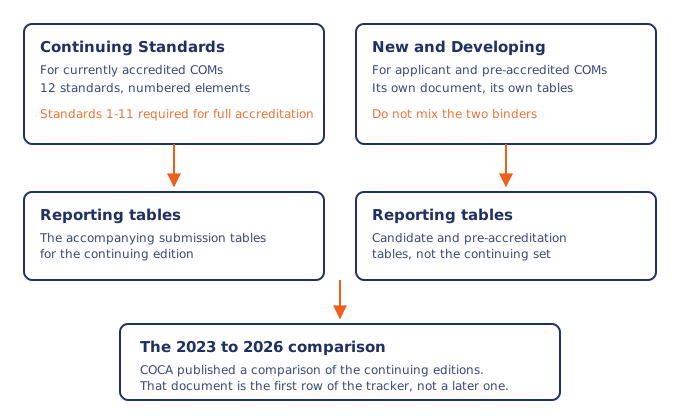
The operational rule that follows: never work from a saved copy. Pull the editions that apply to your next review from osteopathic.org, record the edition date, and settle any argument between a prior crosswalk and the current table of contents by siding with the current table of contents.
The clock, as COCA published it
Two published dates decide which edition is in force. The date that binds you is the review date in your COCA correspondence, read against February 1, 2027.
| Owner | Clock | Artifact | Failure if skipped |
|---|---|---|---|
| Accreditation lead | July 1, 2026 | 2026 edition recorded as in force for the 2026-2027 academic year | Tracking still says 2023 in the header |
| Accreditation lead | Reviews after February 1, 2027 | Edition locked to the 2026 table of contents | A review after the cutoff against a 2023 element list |
| Accreditation lead | Your review date (COCA correspondence) | The edition that actually governs that review | A typical interval used instead of the date that binds you |
| Dean plus accreditation lead | Next leadership meeting | Tracker with real names in the owner column | Workbook treated as the system of record |
July 1, 2026. The 2026 continuing standards (and the 2026 new-and-developing standards) are effective for the 2026-2027 academic year. They apply to colleges with pre-accreditation or accreditation status.
February 1, 2027. Reviews conducted after this date run against the 2026 edition. If the review is after that cutoff and your tracker still uses a 2023 element list, that is a process failure, not a documentation gap.
Your review date. The date that binds you is the one in your COCA correspondence, not a typical interval. Put that date in the tracker first and work backward from it.
Accreditation editions
College of Osteopathic Medicine
Accreditation editions
Effective
July 1, 2026
2026-2027 academic year
Review date
Feb 1, 2027
After this, 2026 edition
Standards 1-11
Required
12 only if COCA is institutional
Pull the 2026 Continuing Standards
Standing
Accreditation lead
On the clock
DoneDiff 2023 tracking against 2026 elements
Diff
Accreditation lead
Before next review
OpenName an owner for each element
Owners
Dean + lead
This term
In progressAttach what you already produce
Evidence
Element owners
All year
StandingA 30-second check. Look at the next review date in your COCA correspondence. If it is after February 1, 2027, the 2026 table of contents is already the working set. The comparison document is the first tracker row.
A few table-of-contents rows worth flagging in a diff. Confirm current numbering on osteopathic.org, because this list is a pointer, not a substitute:
| 2026 TOC pointer | Why flag it in a diff |
|---|---|
| 6.6 Principles of Osteopathic Medicine | Hours reconstructed in a visit year are not hours. |
| 6.11 Comparability Across Clinical Education Sites | Confirm current numbering on osteopathic.org |
| 6.12 Comprehensive Evidence-Based Nutrition Curriculum | If your 2023 tracker has no row for it, that is the diff talking |
| 11.4 COMLEX-USA | Its own 2026 element, not a line inside a broader student-outcomes row |
| 11.9 COCA Annual and Mid-Cycle Reports | In the 2026 table of contents this sits at 11.9, not at the 11.6 slot some older crosswalks still carry |
Do not treat that list as complete. The comparison document is.
The operating model that survives turnover
People → Process → Platform. Named owners run the 2023 and 2026 edition clock as a standing process in the platform. The tracker is a meeting handoff into that process.
One named accreditation lead with real authority. Usually an associate dean or a dedicated accreditation director. This person owns the calendar, the master documents, and the escalation path to the dean.
Element owners, in writing. Every element in the edition that will govern the next review gets a named owner: the person who can produce the evidence, not the most senior person nearby. The owner list is the first thing to update when people leave.
A standing data steward for outcome tables. COMLEX-USA, GME placement, graduation, retention. Most painful review moments are not standards violations; they are a narrative that contradicts a table, because two offices answered the same question from different systems.
The dean's visible sponsorship. Element owners hit walls only the dean can remove. A kickoff where the dean charges the work is worth more than any folder.
Where it goes wrong
The failure points below surface late, cost the most, and are cheapest to prevent early. None of them is a missing standard. Each is a missing owner, a missed clock, or a tracker that still lives in one head.
- The 2023 header. Tracking built on the prior continuing edition, never diffed after July 1, 2026. Cheap fix: the first two rows of the tracker, with a name on them.
- The wrong binder. An applicant or pre-accredited COM working from the continuing standards, or the reverse. The two documents are not interchangeable.
- Hours as archaeology. Instructional load reconstructed from calendars in the months before a visit, instead of computed from the schedule all year.
- Affiliation agreements in email. If you cannot filter by expiration date without searching inboxes, the list is not operational.
- The tracker in one head. Turnover should cost you a person, never a process.
The tracker
Download the COCA edition-transition tracker (Excel), or the plain CSV if you would rather import it into Google Sheets or your own system: every task above as a row, grouped by phase, with columns for the suggested owner, timing, status, and notes. The workbook is a handoff for a meeting (names and dates in a file you can pass around). It is not the system of record. Put real names in the owner column at your next leadership meeting, and the standing list lives in the platform.
Where a platform helps
People hold the edition dates. Process is named owners on the 2023 and 2026 clock. Platform comes last. Medtrics is one such platform. See Medical Schools.
The 2023 and 2026 evidence files are a packet problem, not a visit-year folder. Medtrics keeps every accreditation artifact in one access-controlled repository, categorized, with expiration alerts, and links each artifact as evidence to the standard it supports.
The edition clock is a workflow with owners. It tracks a multi-year accreditation effort, phases, owners, due dates, and directed update requests, in one workflow.
Goals and Outcomes
Needs your attention
Showing top 2 by due dateRequired evidence not linked
Program director · Sep 5, 2026
Unanswered required questions
Unassigned owner · Sep 8, 2026
AY 2026-2027 Annual Program Evaluation
Complete outcomes, evidence, metrics, requests, and action planning before submitting the packet for review.
Improvement goals
8
Open blockers
2
Open actions
5
Overdue actions
1
Demonstration data. Accreditation artifacts live in one access-controlled repository, linked to the standard they support. The workbook is a meeting handoff into that list.
None of this files, certifies, or confers accreditation. Your school files its own COCA reports. None of this replaces the operating model. The edition, the owners, and the dean's sponsorship still do the work; a platform makes the boring structure durable when people leave.
Sources and status
This guide was verified against the following COCA primary sources, each fetched on September 1, 2026:
- AOA accreditation announcements: December 4, 2025 approval of the 2026 Continuing Standards and 2026 New and Developing Standards; effective July 1, 2026 for the 2026-2027 academic year; applicable to colleges with pre-accreditation or accreditation status; reviews after February 1, 2027 run against the new edition. osteopathic.org/accreditation/announcements
- Accreditation of Colleges of Osteopathic Medicine: COM Continuing Accreditation Standards (2026 edition): cover date February 1, 2026; effective July 1, 2026; for reviews occurring after February 1, 2027. Table of contents used for the element-number pointers above. Introduction used for the 12-standard structure, the requirement that standards 1-11 be met for full accreditation, and Standard 12 applying only when COCA is the institutional accreditor. osteopathic.org/wp-content/uploads/COCA-2026-COM-Continuing-Accreditation-Standards.pdf
- COCA accreditation standards listing (page last updated July 2026): the 2026 reporting tables and the published comparison of the 2023 and 2026 continuing standards. osteopathic.org/accreditation/standards
Element language is not quoted. Confirm current numbering and submission requirements on osteopathic.org before you budget anyone's year around a summary.
COCA and the American Osteopathic Association are named descriptively. This article is an independent operational guide from Medtrics, not COCA guidance, and nothing here promises any accreditation outcome; the work does that, or nothing does.