
Sometime in late June, while your program was graduating one class and onboarding the next, the ACGME's Accreditation Data System rolled over to the 2026-2027 academic year and moved every resident and fellow in your program to Unconfirmed status. Nothing looked broken. But from the accreditor's side of the screen, your roster became a question, and the season that answers it had already begun.
That flip is a truer picture of ACGME accreditation than the one most institutional calendars encode. Accreditation is not an event at long intervals. It is a data relationship that renews every year, mostly inside systems, on schedules the ACGME sets. This guide is the operational version for program directors, DIOs, and accreditation leads. It covers the requirement documents in force, the annual rhythm as the ACGME's systems run it, the structure that makes that rhythm boring, and the failure points that surface late. A downloadable annual-cycle tracker (branded Excel, with a plain-CSV alternative) is linked at the end as a meeting handoff, not as the system of record.
Verified September 1, 2026 against ACGME Common Program Requirements and the June 22 and July 6 e-communications. Sources at the end.
First, the documents in force
Three layers of ACGME requirement documents govern a residency or fellowship program, and each carries an effective date that matters more than its title.
The Common Program Requirements. The baseline for every accredited program. As of the September 1, 2026 check above, the Common Program Requirements page (all four posted versions effective July 1, 2026) listed four versions (Residency, Fellowship, One-Year Fellowship, and Post-Doctoral), each effective July 1, 2026. If your compliance tracking was built on a prior edition, the first task in the tracker below is a diff, not a review.
Your specialty's Program Requirements. Each specialty's requirements are revised on their own cycle. Pull the current edition from your specialty's page on acgme.org at every academic-year rollover, record its effective date in your tracker, and retire the copy saved during your last review.
The Institutional Requirements. The sponsoring institution's side of the relationship, and the DIO's home document. The same rule applies: current edition, noted effective date, one named owner who re-checks it each year.
A requirements document is only as current as the last time someone checked its effective date. The tracker below makes that a standing annual task with a name on it, which is the whole trick.
The year, as the ACGME's systems run it
| Owner | Clock | Artifact |
|---|---|---|
| Program coordinator plus PD | Late June Unconfirmed rollover | Confirmed roster |
| ADS update owner | Program's ADS Important Dates window | Submitted Annual Update |
| DIO round-trip owner | One week before the ADS date | Update in front of the DIO with room to return |
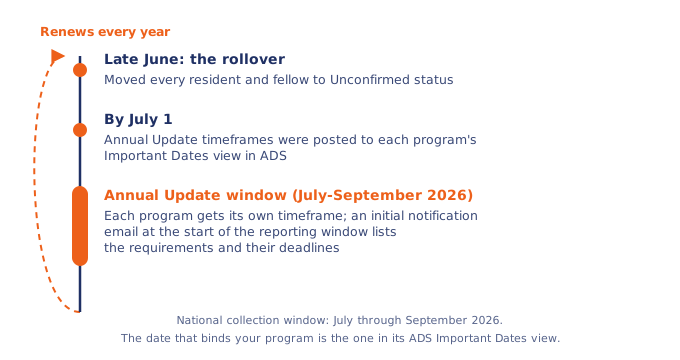
Late June: the rollover. Per the ACGME's June 22, 2026 e-communication, ACGME Cloud, ADS, and the Case Log System converted to Academic Year 2026-2027 over the June 26-27 weekend. After that conversion, every resident and fellow had an Unconfirmed status that programs need to update. Annual Update timeframes were posted to each program's Important Dates view in ADS by July 1. The rollover is the starting gun for the reporting year, and it fires whether anyone in your program is watching.
July through September 2026: the ADS Annual Update. Per the ACGME's July 6, 2026 e-communication, the Academic Year 2026-2027 Annual Update is collected between July and September 2026, each program gets its own timeframe, and an initial notification email at the start of the reporting window lists the requirements and their deadlines. The collection window is national. The date that binds your program is the one in its ADS Important Dates view. This guide stays at who owns the update and when it must be finished, which is earlier than the window suggests, for the next reason.
Accreditation year
Internal Medicine · AY 2026-2027
Accreditation year
Internal deadline
Sep 12
1 week ahead of ADS
DIO review
In the buffer
Confirm mechanics with GME
Packet readiness
Standing
Earned all year, not in August
Confirm Unconfirmed roster
Rollover
Coordinator
Jul 3
OpenCalendar ADS Important Dates
Season start
Coordinator
Jul 1
DoneDIO round-trip buffer
Internal
Program director
1 week ahead
SetAnnual Update: this program
ADS window
PD + coordinator
Sep 12
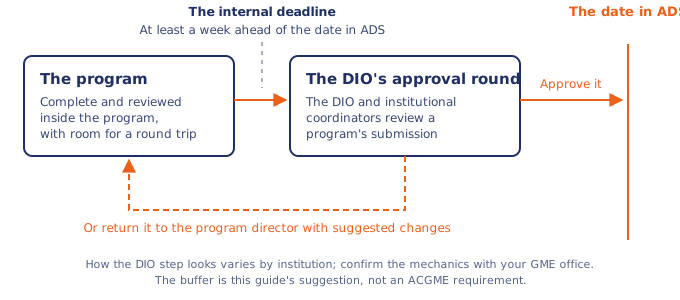
Not startedThe DIO's approval round. The ACGME's help-center overview describes a review step (effective July 1, 2021) for sponsored programs' Annual Updates: the DIO and institutional coordinators can review a program's submission and approve it, or return it to the program director with suggested changes. How that step looks varies by institution, so confirm the mechanics with your GME office. What it means operationally does not vary: a program's real deadline sits earlier than the date in ADS, because the update has to be complete, reviewed inside the program, and in front of the DIO with room for a round trip. For a DIO, the mirror image holds: every sponsored program that finishes early is one fewer late-September return cycle.
A 30-second check. Open this program's ADS Important Dates view. Write the date in the tracker. The rest of this guide works backward from that date, not from September.
Milestones reporting. Milestones submissions run on their own scheduled windows, with their own roles and their own failure modes. Enter your specialty's windows in the tracker below alongside the Annual Update rather than treating them as a separate season. Confirm current windows on acgme.org; they are not restated here.
Milestone assessments
Milestone Assessment Matrix
Average entrustment levels by learner and assessment period
| Learner | 2025-2026 Mid-Year | 2025-2026 Year-End |
|---|---|---|
| PGY-1 A | 2.0 | 2.4 |
| PGY-2 B | 3.1 | 3.4 |
| PGY-3 C | 3.8 | 4.1 |
| PGY-3 D | 2.9 | - |
| PGY-4 E | 4.2 | 4.6 |
Demonstration data. Milestones run on their own windows. Confirm current windows on acgme.org; they are not restated here.
The pages you check live, not from memory
Some parts of accreditation change faster than any published guide, and this is where secondhand summaries, vendor content included, quietly go wrong. Three areas belong on a check-the-source list rather than in a paraphrase:
- Site visits. How the ACGME schedules and conducts visits is defined by the current Site Visit pages on acgme.org, not by how the process worked the last time your institution went through one. If an internal planning document describes a visit model with a fixed multi-year date on it, make that the first thing you re-check, not the last.
- Self-study. What the ACGME currently expects programs to do, and to submit, around self-study has its own page. Confirm the current state before you budget anyone's year around an expectation that may have changed.
- Initiatives. Before citing any ACGME initiative in an internal plan, check its current status on acgme.org. Initiatives conclude, and plans built on concluded ones age badly.
The operational move is the same for all three: at every academic-year rollover, one named person opens the current pages, notes what changed against the tracker, and settles any argument between a summary and the source by siding with the source.
The operating model that makes it boring
People → Process → Platform. Named owners run the year as a standing process. The tracker and the DIO buffer are that process. A platform comes last, to make the process survive turnover.
One named owner of the accreditation calendar. In a program, that is usually the program director plus the coordinator who drives the system; at the institution, the DIO's office. If you are the coordinator reading this, you are probably that owner in practice already; the tracker exists to make that visible. The owner's job is not to do every task. It is to make sure every date has a name next to it.
A living tracker, not a visit-year artifact. Windows, owners, status, in one shared and access-controlled place. If the tracker only exists in the weeks before something is due, every season starts with archaeology.
Data hygiene as a standing task. The update season is short for programs whose rosters, evaluations, and program records were maintained all year, and long for programs reconstructing them in August. Confirming a record is fast; reconstructing why it is wrong is not.
The buffer, in writing. Put the DIO round trip on the calendar as a real step with real time attached, not a hope that the DIO is free the day before ADS closes.
The program director's hours, booked early. Parts of the season need the program director personally. Book that time when the window opens, not when it closes; an hour held in July costs nothing, and the same hour in the closing week is the most expensive hour of the season.
Where it goes wrong
- The saved-copy requirement set. Tracking built on a prior edition of the requirements and never diffed after July 1. Cheap fix: the rollover checklist row, with a name on it.
- The Unconfirmed roster, discovered mid-window. Nothing looks broken until each record is checked, so it gets checked late. Start the season there.
- The one-person form. The Annual Update treated as something one person fills out, instead of a program task with data owners, due dates, and the program director's time attached.
- No room for the return. A submission that reaches the DIO the day before the window closes has spent its entire buffer; a returned one has less than none.
- The tracker in one head. Every date, owner, and artifact lives in a shared, access-controlled place from the moment it exists. Turnover should cost you a person, never a process.
The tracker
Download the ACGME annual-cycle tracker (Excel), or the plain CSV if you would rather import it into Google Sheets or your own system: every task above as a row, grouped by phase, with columns for the suggested owner, timing, status, and notes. The workbook is a handoff for a meeting (names and dates in a file you can pass around). It is not the system of record. Put real names in the owner column at your next program or institutional meeting, and next season becomes a plan instead of a scramble.
Where a platform helps
People hold the dates. Process is the standing year. Platform comes last. Medtrics is one such platform. The GME accreditation map for the same year is at GME Leaders.
The Unconfirmed roster is a records problem. Enrollment, evaluations, and outcomes live in one system of record with a governed KPI layer and exportable analytics, so confirming a record in July is a check, not a reconstruction.
The packet is not a visit-year folder. Medtrics keeps every accreditation artifact in one access-controlled repository, categorized, with expiration alerts, and links each artifact as evidence to the standard it supports.
The year is a workflow with owners. It tracks a multi-year accreditation effort, phases, owners, due dates, and directed update requests, in one workflow.
Goals and Outcomes
Needs your attention
Showing top 2 by due dateRequired evidence not linked
Program director · Sep 5, 2026
Unanswered required questions
Unassigned owner · Sep 8, 2026
AY 2026-2027 Annual Program Evaluation
Complete outcomes, evidence, metrics, requests, and action planning before submitting the packet for review.
Improvement goals
8
Open blockers
2
Open actions
5
Overdue actions
1
Demonstration data. Packet artifacts live in one access-controlled repository, linked to the standard they support.
None of this replaces the operating model. The calendar, the owners, and the buffer still do the work; a platform makes the boring structure durable when people leave.
Sources and status
This guide was verified against the following ACGME primary sources, each fetched on September 1, 2026:
- ACGME Common Program Requirements page: four posted versions (Residency, Fellowship, One-Year Fellowship, Post-Doctoral), each effective July 1, 2026. acgme.org/what-we-do/accreditation/common-program-requirements
- ACGME e-communication, June 22, 2026: academic-year conversion over the June 26-27 weekend; after conversion, all residents and fellows have Unconfirmed status; Annual Update timeframes posted to the ADS Important Dates view by July 1. acgme.org/newsroom/e-communication/2026/june-22-2026
- ACGME e-communication, July 6, 2026: Academic Year 2026-2027 Annual Update collected July through September 2026, per-program timeframes, initial notification email listing requirements and deadlines. acgme.org/newsroom/e-communication/2026/july-6-2026
- ACGME help center, "DIO Approval of Sponsored Programs ADS Annual Update Overview" (process effective July 1, 2021): cited from the overview's title and published excerpt; the help-center hosts blocked direct fetching, so the copy above describes the step as the overview describes it and defers to your GME office on the mechanics.
Site-visit practice, self-study expectations, and the status of ACGME initiatives were not re-verified for this page, which is why the guide points you at the current acgme.org pages for those areas instead of restating them.
ACGME is named descriptively. This article is an independent operational guide from Medtrics, not ACGME guidance, and nothing here promises any accreditation outcome; the work does that, or nothing does.