
Somewhere on your campus there is a shared drive with a folder named something like "CCNE 2018." Inside it is the last on-site evaluation: the old self-study, a zip of appendices, a spreadsheet of who owned which key element. Most of those people have new jobs now. The next evaluation is closer than the last one feels, and CCNE already publishes two Standards editions with a date that chooses between them. The question that lands on the accreditation lead's desk is not philosophical. It is: which edition governs us this cycle, who produces each piece, and when does each piece have to exist?
This guide is the operational answer for nursing deans and accreditation leads at baccalaureate, master's, DNP, and post-graduate APRN certificate programs: the named documents in force, the January 1, 2027 edition clock, the working structure that produces a self-study and a Continuous Improvement Progress Report without heroics, and the failure points that show up late, when they are expensive. A downloadable accreditation tracker (branded Excel workbook, with a plain-CSV alternative) is linked at the end as a meeting handoff, not as the system of record, with owner and timing columns so the work is visible years before the visit. The clinical-placement and preceptor walkthrough lives on the nursing programs page; this page stays on the calendar and the owners.
Verified September 1, 2026 against CCNE 2024 and 2026 Standards, Procedures, and the July 7, 2026 Board announcement. Sources at the end.
First, the documents in force
CCNE accreditation of baccalaureate and graduate nursing programs runs on a small number of named documents. Managing the process starts with knowing exactly which ones govern you, in which edition.
The Standards. CCNE publishes Standards for Accreditation of Baccalaureate and Graduate Nursing Programs. Two editions are live. The Amended 2024 Standards went into effect January 1, 2025. The Amended 2026 Standards go into effect January 1, 2027. Both editions organize the review as four Standards: Standard I, Program Quality: Mission and Governance; Standard II, Program Quality: Institutional Commitment and Resources; Standard III, Program Quality: Curriculum and Teaching-Learning Practices; Standard IV, Program Effectiveness: Assessment and Achievement of Program Outcomes. The key element is the unit a program is actually written against. The four titles look familiar from cycle to cycle. The elaborations do not. Do not restate key-element letters from a saved crosswalk. Pull the edition that will govern the next on-site, and assign owners against that document.
The Procedures. Procedures for Accreditation of Baccalaureate and Graduate Nursing Programs, amended January 14, 2025, is the process manual: self-study, on-site evaluation, term of accreditation, annual reports, the CIPR, compliance reports, and substantive change. If your tracker was built on an older procedures file, the first task is a diff, not a review.
The self-study and the Program Information Form. The program conducts a self-study and prepares an analytic document that addresses all accreditation standards and key elements. Whether one program or several are under review, a single self-study document is prepared. The Program Information Form is filed with it. CCNE publishes self-study templates for the 2024 Standards and for the 2026 Standards. Use the template that matches the edition that governs the visit.
General Advice and the on-site checklist. CCNE publishes General Advice for Hosting a CCNE On-Site Evaluation (the copy fetched for this guide is dated July 2026) and a checklist of key steps in planning the on-site. Those two files are where the page caps, the six-week upload, the virtual resource room, and the agenda lead times live. They are not optional color.
The CIPR, the annual report, and substantive change. Between comprehensive on-site evaluations the process does not go quiet. The chief nurse administrator submits an annual report each year. A Continuous Improvement Progress Report is generally submitted at the mid-point of the accreditation term. Substantive changes are notified on their own clock. Reporting a change inside the CIPR does not replace the substantive-change notification. The CIPR and the annual report sit on the same tracker as the edition clock.
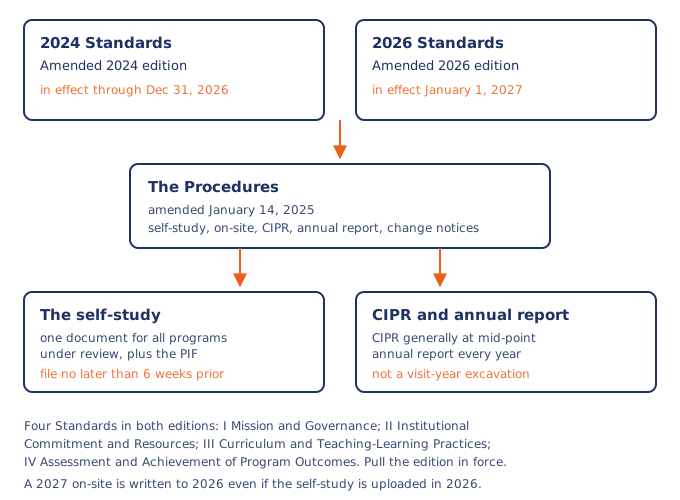
The operational rule that follows: never work from a saved copy. Pull the edition that will govern the next on-site, the current Procedures, the matching self-study or CIPR template, and General Advice from the CCNE site. Record the edition date. Settle any argument between a prior binder and the current files by siding with the current files. Key-element language is not restated. Whatever this page says, the authoritative version of every requirement is the current edition on ccneaccreditation.org, not any article, including this one.
The edition clock
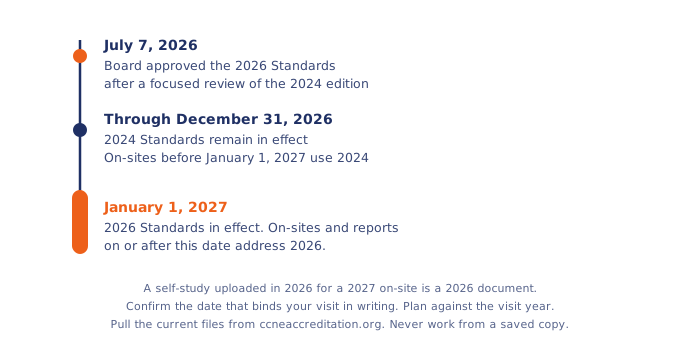
The on-site date chooses the Standards edition. Through December 31, 2026 the 2024 Standards remain in effect; from January 1, 2027 the 2026 Standards govern, including a self-study filed before that date for a 2027 visit.
| Body | Clock | What it is not |
|---|---|---|
| 2024 Standards | Through December 31, 2026. On-sites before January 1, 2027. | The edition for a 2027 on-site |
| 2026 Standards | From January 1, 2027. On-sites and reports on or after that date. | Optional until the visit year is 2027 |
| Self-study filed in 2026 for a 2027 on-site | Board announcement: write to 2026. | The HTML page's reports-before-2027 line as the sole rule |
Through December 31, 2026. The 2024 Standards remain in effect. Programs hosting an on-site evaluation before January 1, 2027 are assessed using the 2024 Standards.
January 1, 2027. The 2026 Standards go into effect. The July 7, 2026 Board announcement is the clearer of the two public statements: all baccalaureate and graduate programs hosting a CCNE on-site evaluation and/or submitting a report on or after January 1, 2027 are required to address the 2026 Standards. The 2024 Standards remain in effect through December 31, 2026.
The self-study you file in 2026 for a 2027 visit. The same announcement is explicit: that rule includes a self-study document submitted to CCNE prior to January 1, 2027, for an on-site evaluation occurring in 2027. The Standards, Procedures, and Guidelines page on the CCNE site says reports submitted before January 1, 2027 must address the 2024 Standards. That is a real discrepancy, not a rounding error. Plan against the visit year. If the on-site is in 2027, write the self-study to the 2026 Standards even if you upload it in 2026, unless CCNE staff confirms otherwise in writing. Put that confirmation in the tracker.
Your date. Continued accreditation of a CCNE-accredited program may be granted for a maximum period of 10 years. Initial accreditation of a baccalaureate, master's, or DNP program may be granted for up to 5 years. Your program's actual next-evaluation year lives in CCNE correspondence and in the public directory of accredited programs. That date, not a typical interval, is the one to plan against.
A 30-second check. Open your last accreditation action letter. Write the next on-site year in the tracker. If that year is 2027 or later, the 2026 Standards are already the working set. The 2018-to-2026 crosswalk is the first tracker row, not a later one.
AACN, the member organization, publishes The Essentials: Core Competencies for Professional Nursing Education. A 2026 edition was posted in April 2026. CCNE publishes its own resource on the required components of the Essentials, one aligned to the 2024 Standards (in effect until January 1, 2027) and one aligned to the 2026 Standards. That resource is CCNE's, not a substitute for reading the Standards. This page does not restate domain or competency counts from AACN. Essentials mapping is member-org curriculum context, not a CCNE Standards clock, and it is not captioned here.
The operating model that survives turnover
The expensive failures are not usually ignorance of the four Standards. They are a process that lives in one person's head. The structure below is boring on purpose.
People → Process → Platform. Named owners run the edition clock as a standing process. The tracker, the CIPR, and the annual report are that process. A platform comes last, to make the process survive turnover.
A named accreditation lead with real authority. Usually an associate dean or a dedicated accreditation director, working with the chief nurse administrator. This person owns the calendar, the master documents, and the escalation path to the dean. If this role is somebody's fifth job, the tracker below is fiction.
Standard owners, in writing. Every one of the four Standards in the edition that will govern the next on-site gets a named owner: the person who can produce the evidence and the narrative, not the most senior person nearby. The owner list is a living document. It is the first thing to update when people leave.
A standing data steward for outcomes. Completion, licensure and certification results, employment, graduate and employer feedback. Most painful visit moments are not standards arguments. They are a narrative on page one that contradicts a table in the appendices, because two offices answered the same question from different systems. This page reports no program's rates.
A CIPR owner who is not invented in year five. The CIPR is generally due at the mid-point of the term. If the term is 10 years, that is not a surprise. Name the owner now. Put the CIPR on the same tracker as the annual report and the edition clock.
The dean's visible sponsorship. Standard owners hit walls only the dean can remove: data access, faculty time, honest answers to uncomfortable questions, and any plan that is a substantive change. A kickoff where the dean personally charges the work is worth more than any folder.
The timeline, built backward
Dates CCNE sets override everything here. Put them in the tracker first, including the CIPR due date and the annual-report row, not only the visit.
| Owner | Clock | Artifact |
|---|---|---|
| Accreditation lead | A minimum of 12 months in advance | On-site scheduled |
| Chief nurse administrator | No later than 8 weeks prior | Agenda with the team leader |
| Accreditation lead | No later than 6 weeks prior | Single self-study, Program Information Form, agenda, third-party verification |
| Accreditation lead | At least 7 days prior | Virtual resource room by standard and key element |
| Chief nurse administrator | Each year | Annual report on the same tracker |
| CIPR owner | Mid-point of the term | CIPR against the matching template |
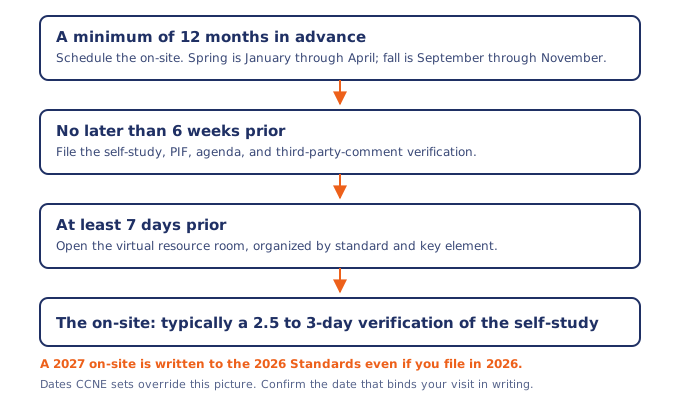
A minimum of 12 months in advance. On-site evaluations are generally scheduled with CCNE a minimum of 12 months in advance. Spring evaluations are generally January through April. Fall evaluations are generally September through November.
About 8 weeks out. General Advice encourages the chief nurse administrator to develop the agenda no later than 8 weeks prior to the evaluation, then share it with the team leader.
No later than 6 weeks prior. The Procedures and General Advice agree: the program must submit the self-study (including appendices), the Program Information Form, the agenda, and verification that communities of interest were given the opportunity to submit third-party comments, no later than 6 weeks prior to the scheduled on-site evaluation. Constituents must have been notified at least 2 months before the on-site; CCNE receives written third-party comments until 21 days before. General Advice: the self-study document is to be no longer than 110 pages of narrative for one or two degree or certificate programs, and no longer than 120 pages of narrative for three or four. The introduction and appendices are excluded from that cap.
At least 7 days prior. The program must provide the team access to evaluation resource materials, commonly called a virtual resource room, at least 7 days prior to the on-site. Organize it by standard and key element. An index is not decoration.
The on-site itself. The comprehensive on-site evaluation typically occurs over a 2.5 to 3-day period. CCNE reserves the right to lengthen it when there are multiple tracks, campuses, or a consortium. The team verifies the self-study. It does not invent the record.
Every year that is not a visit year. File the annual report. If a CIPR is due, file it on or before the due date, and no sooner than 30 days before, against the CIPR template that matches the edition in force. The March 2026 CIPR template is the current general file; CCNE also posted a template for December 2026 submissions only. Do not alter the standard, key element, or elaboration statements in the template. The completed CIPR should not exceed 95 pages, excluding appendices.
When something actually changes. The substantive change notification must be received by CCNE no earlier than 90 days prior to implementation or occurrence of the change, and no later than 90 days after, unless otherwise noted. Adding a track inside an already-accredited degree or certificate program is on that list. Reporting it later in the CIPR is not the same as notifying it.
Where it goes wrong
- The 2024 binder. Tracking built on the Amended 2024 Standards, never diffed after the July 7, 2026 approval. Cheap fix: the first row of the tracker, with a name on it.
- The 2026 visit written to 2024. An internal calendar that treats a late-2026 self-study upload as a 2024 document because the HTML page says reports submitted before January 1, 2027 address 2024. The Board announcement says a 2027 on-site is a 2026 self-study. Confirm in writing. Plan against the visit year.
- The CIPR as archaeology. If the CIPR is assembled from a visit-year excavation, the mid-point report has already failed its job. The annual report is supposed to reduce that pile. Use it that way.
- One self-study per track. General Advice is explicit: a single self-study document addresses all programs under review. Separate novels for BSN, MSN, DNP, and the post-graduate APRN certificate are not the process.
- Narratives that contradict tables. Completion, licensure, certification, employment. Assign one data steward, one source system per table, and a consistency pass before anything is uploaded. This page does not report any program's rate.
- A substantive change already in motion. Ninety days before or ninety days after is a window, not a suggestion to file when someone remembers. A new track that reaches the dean as a fait accompli has already spent the buffer.
- The virtual resource room as a dump. Seven days is not enough time for a team to reconstruct a filing system you did not build. Organize by standard and key element from the start of the cycle.
- Single-person knowledge. Every artifact (master self-study, owner list, correspondence, this tracker) lives in a shared, access-controlled location the moment it exists. Turnover should cost you a person, never a process.
The tracker
Download the CCNE accreditation tracker (Excel), or the plain CSV if you would rather import it into Google Sheets or your own system: every task above as a row, grouped by phase, with columns for the suggested owner, timing, status, and notes. The workbook is a handoff for a meeting (names and dates in a file you can pass around). It is not the system of record. Put real names in the owner column at your next leadership meeting, and the next cycle becomes a plan instead of a folder.
Where a platform helps
People hold the dates. Process is the standing edition clock, the CIPR, and the annual report on one tracker. Platform comes last. Medtrics is one such platform. See Nursing Programs.
The packet is not a visit-year folder. Medtrics keeps every accreditation artifact in one access-controlled repository, categorized, with expiration alerts, and links each artifact as evidence to the standard it supports.
The edition clock, the CIPR, and the annual report are a workflow with owners. It tracks a multi-year accreditation effort, phases, owners, due dates, and directed update requests, in one workflow.
Goals and Outcomes
Needs your attention
Showing top 2 by due dateRequired evidence not linked
Program director · Sep 5, 2026
Unanswered required questions
Unassigned owner · Sep 8, 2026
AY 2026-2027 Annual Program Evaluation
Complete outcomes, evidence, metrics, requests, and action planning before submitting the packet for review.
Improvement goals
8
Open blockers
2
Open actions
5
Overdue actions
1
Demonstration data. Packet artifacts live in one access-controlled repository, linked to the standard they support.
None of this replaces the operating model. The calendar, the owners, and the dean's sponsorship still do the work. A platform makes the boring structure durable when people leave.
Sources and status
This guide was verified against the following CCNE primary sources, each fetched on September 1, 2026. The CCNE site at ccneaccreditation.org canonicalizes to the CCNE section of aacnnursing.org; the PDFs below are CCNE publications.
- Standards, Procedures, and Guidelines page: 2024 Standards effective January 1, 2025 and used for on-sites before January 1, 2027; 2026 Standards effective January 1, 2027 and used for on-sites after that date. aacnnursing.org, standards-procedures-guidelines
- July 7, 2026 Board announcement: 2026 Standards in effect January 1, 2027; on-sites and reports on or after that date address 2026, including a self-study submitted before January 1, 2027 for a 2027 on-site; 2024 Standards remain in effect through December 31, 2026. CCNE press release
- Standards for Accreditation, Amended 2024: four Standards (I Mission and Governance; II Institutional Commitment and Resources; III Curriculum and Teaching-Learning Practices; IV Assessment and Achievement of Program Outcomes). CCNE-Education-Standards-2024.pdf
- Standards for Accreditation, Amended 2026: same four Standard titles in the table of contents. CCNE-Education-Standards-Updated-2026.pdf
- Procedures, amended January 14, 2025: six-week self-study filing; 2.5 to 3-day on-site; 12-month scheduling; maximum continued term of 10 years; initial term up to 5 years; CIPR at mid-point; annual report; 90-day substantive-change window; 7-day virtual resource room; third-party comments. Procedures.pdf
- General Advice, July 2026: single self-study; 110-page and 120-page narrative caps; 6-week upload; 8-week agenda; 7-day virtual resource room. General-Advice-Education.pdf
- CIPR page: March 2026 template; December 2026 submissions template; 95-page cap; do not alter standard, key element, or elaboration statements. CIPR, baccalaureate and graduate
- New-applicant page: new applicant status is not accreditation; self-study and on-site within 2 years of acceptance. Application process
AACN publishes The Essentials: Core Competencies for Professional Nursing Education, including a 2026 edition. That is member-org curriculum context, not a substitute for the Standards text. aacnnursing.org/essentials
CCNE and AACN are named descriptively. This article is an independent operational guide from Medtrics, not CCNE or AACN guidance, and nothing here promises any accreditation outcome; the work does that, or nothing does.